Plant Health Care Specialists
Oak Wilt Treatment in North Augusta, Aiken, and the CSRA
Worried your oak has oak wilt? It is one of the most serious oak diseases in the country, but it is far less common in our area than the look-alike problems that cause most oak decline here, and telling them apart is the whole point. Arborwright diagnoses what is actually wrong with your oak and treats oak wilt by the established protocol when it is truly confirmed. Serving North Augusta, Aiken, Augusta, Evans, Martinez, and the surrounding CSRA.
- Licensed Applicator
- Biology Degreed Team
- Pest & Disease Treatment
Get your FREE
Tree Inspection
We’ll call you within one business day to schedule your free on-site inspection. No obligation, no hard sell, no upsells you don’t need.
By submitting, you agree we may contact you by phone, text, or email about your request. Msg/data rates may apply. Reply STOP to unsubscribe. See our Privacy Policy.

What is oak wilt?
Oak wilt is a deadly fungal disease that clogs an oak’s water-conducting vessels, causing the leaves to wilt and brown and often killing the tree within weeks to months, spread between oaks through connected roots and by sap beetles. It is widespread in Texas and the Midwest and present at the edges of the Southeast, but uncommon in the immediate CSRA, where most wilting oaks turn out to have something else. Arborwright diagnoses and, when confirmed, treats oak wilt across North Augusta, Aiken, and the CSRA.
What does oak wilt look like?
Oak wilt has a fast, specific look: leaves wilting and discoloring from the top of the tree down, often dropping while still partly green, with a tree going from healthy to dying in a single season. Several far more common oak problems in the CSRA look alarming but are not oak wilt, which is why the signs below are a starting point, not a diagnosis.
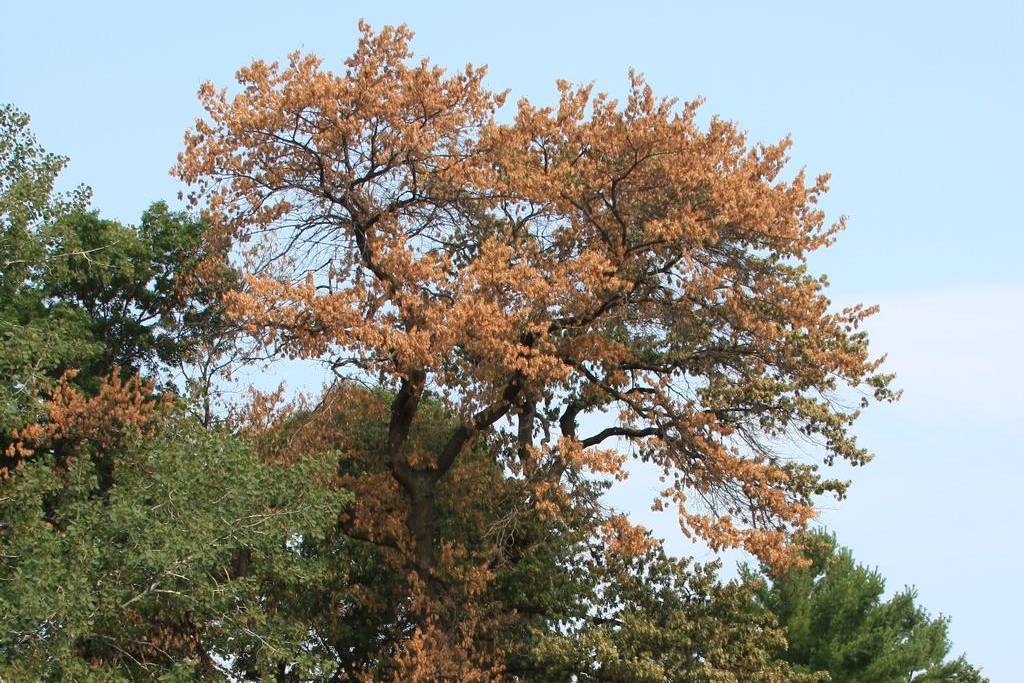
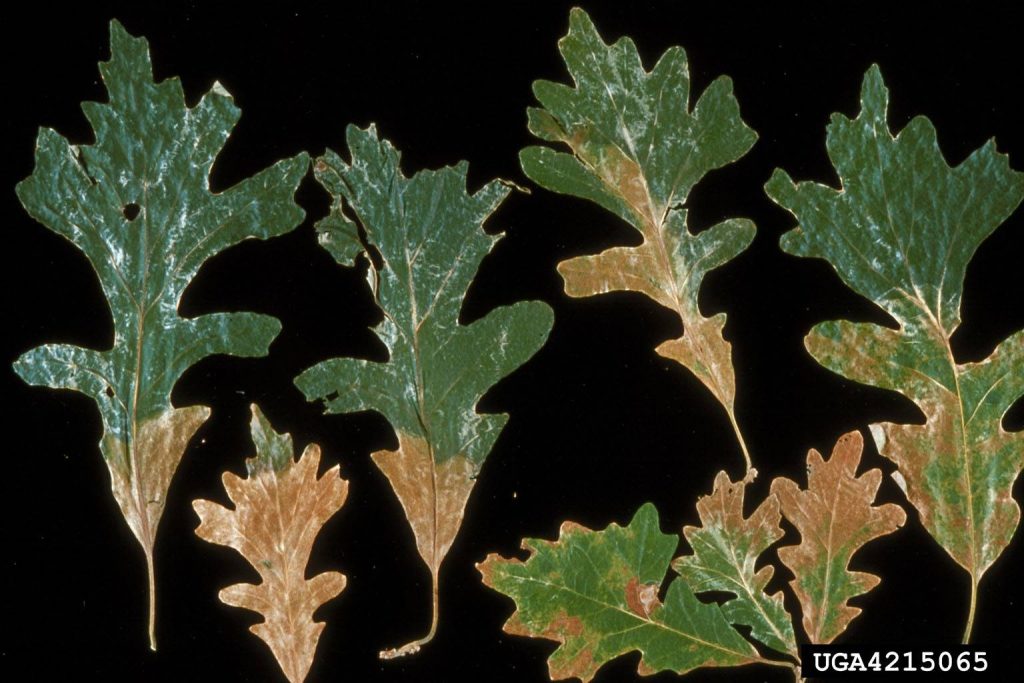
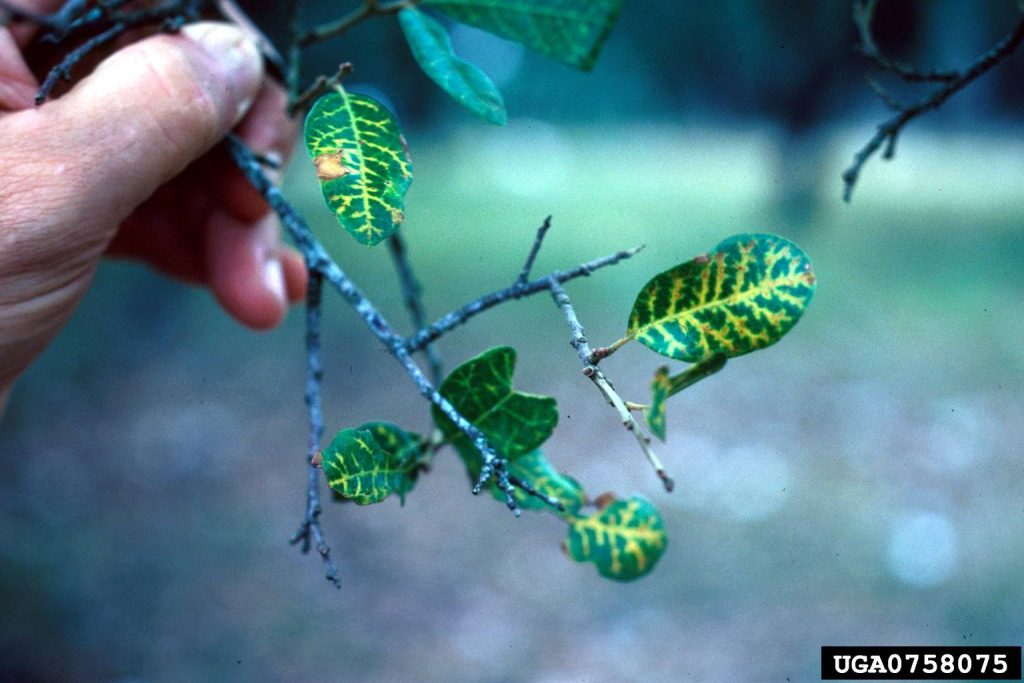
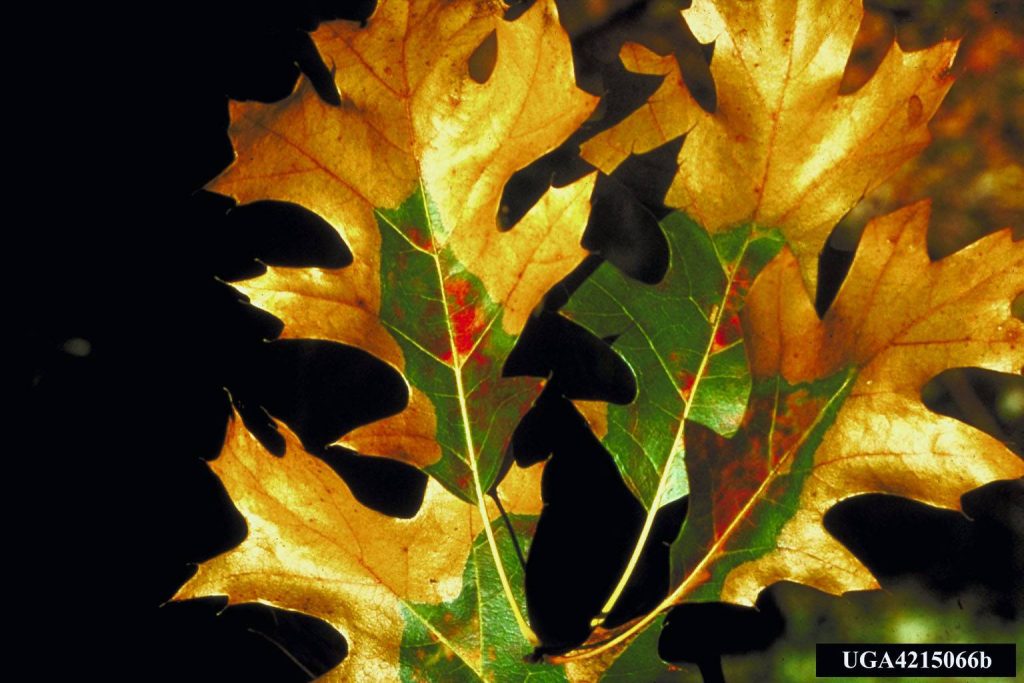
- Leaves wilting and browning from the top down
- Green or half-green leaves dropping early
- Browning along the leaf veins or edges
- Rapid decline over weeks, not years
- Several nearby oaks declining together
- An oak pruned or wounded last spring
Not sure what is wrong with your oak? Send us a photo of the leaves and the whole tree for free input within 24 hours.
Is oak wilt a problem in the CSRA?
Oak wilt is a relatively new arrival to the CSRA but its recency should be of no less concern. Fast-acting and deadly, the fungus is capable of cutting off vascular flow in red oaks, strangling even healthy oaks over a single summer. White oaks, including live oaks, are at less risk, but can fall victim nonetheless.
The fungus spreads two ways: underground, through root grafts that connect neighboring oaks, and via insects, when sap beetles carry fungal spores from infected tree to healthy ones. The second route is why pruning your tree at the wrong time of year can lead to infection: sap beetles are attracted to the smell of cut and wounded wood and are capable of entering the tree through these injury sites.
Once established, oak wilt can move quickly through a stand of interconnected oaks. What begins as a single declining tree can become a much larger problem, with otherwise healthy trees becoming infected through their roots. This is what makes early detection particularly important. By the time an oak is visibly dying, the disease may already have reached its neighbors.
What can be particularly tricky about oak wilt is that its symptoms thoroughly mimic other less damaging diseases and stressors: drought, bacterial leaf scorch, buried root flare, and others all produce symptoms that can be difficult to differentiate. Incorrectly assuming the cause of leaf wilt can lead to wasted effort or unnecessary death.
At Arborwright, we approach oak wilt as a disease-management problem rather than simply an application. We evaluate the affected tree, look for evidence of transmission to neighboring oaks, and determine whether the symptoms are consistent with oak wilt or one of its many look-alikes. When necessary, we work with Clemson Extension for laboratory confirmation. From there, management depends on the species of oak, the stage of infection, and the risk to the healthy trees around it.

How does Arborwright treat oak wilt?
Step 01 · Confirm the diagnosis
Before anything, we confirm whether it is actually oak wilt or one of the common look-alikes, since the symptoms overlap with several harmless or unrelated problems. Where it matters, a lab test on the right sample settles it. The wrong diagnosis means the wrong treatment.
Step 02 · Inject high-value oaks
For a confirmed case caught early, or a healthy high-value oak at genuine risk, propiconazole (Alamo) is injected into the root flare by a Licensed Applicator. It protects and suppresses, working best before or early in infection, and it is not a cure for a tree already in steep decline.
Step 03 · Stop the spread
Because oak wilt moves through connected roots and fresh wounds, stopping spread can mean severing root grafts between oaks, removing a dead oak properly, and not pruning oaks during the high-risk spring and early summer window. An oak already lost comes down to protect the rest.
Step 04 · Protect and monitor
We protect the surrounding healthy oaks, set a pruning calendar that avoids the risky season, and monitor the trees over the following seasons. Where the cause turned out to be a look-alike instead, we treat that for what it is.
What to expect with an oak wilt diagnosis
DAY 0
Diagnosis & testing
We examine the oak, rule the look-alikes in or out, and confirm whether it is actually oak wilt before recommending treatment.
IF CONFIRMED
Treatment
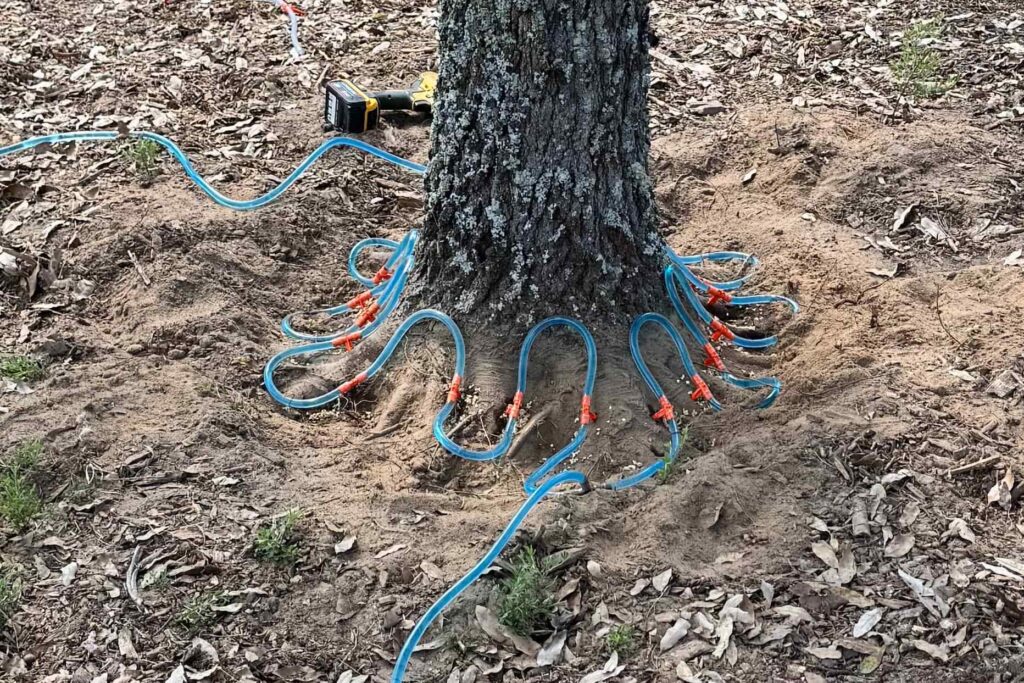
In most cases, infected trees must be removed to prevent the spread to neighbors, though some exceptions can be made if the infection is caught early. Regardless, preventative treatments are performed on nearby oaks to stop the disease from spreading.
SEASON 1
Response
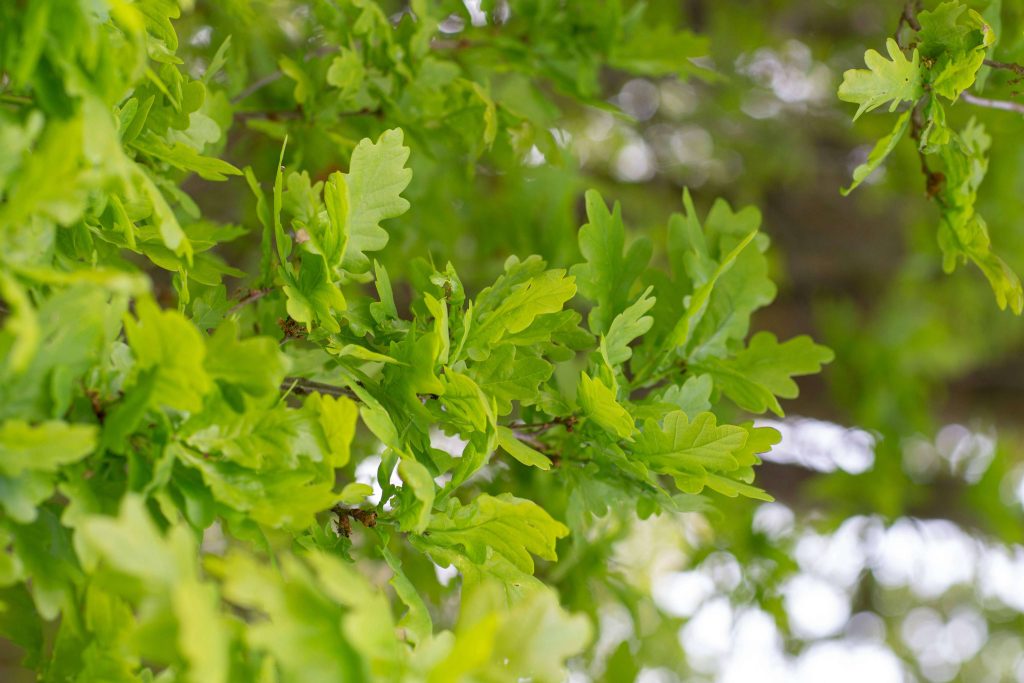
Any treated oaks are closely monitored for signs of disease spread, and pruning of monitored trees is delayed for at least one year.
ONGOING
Prevention
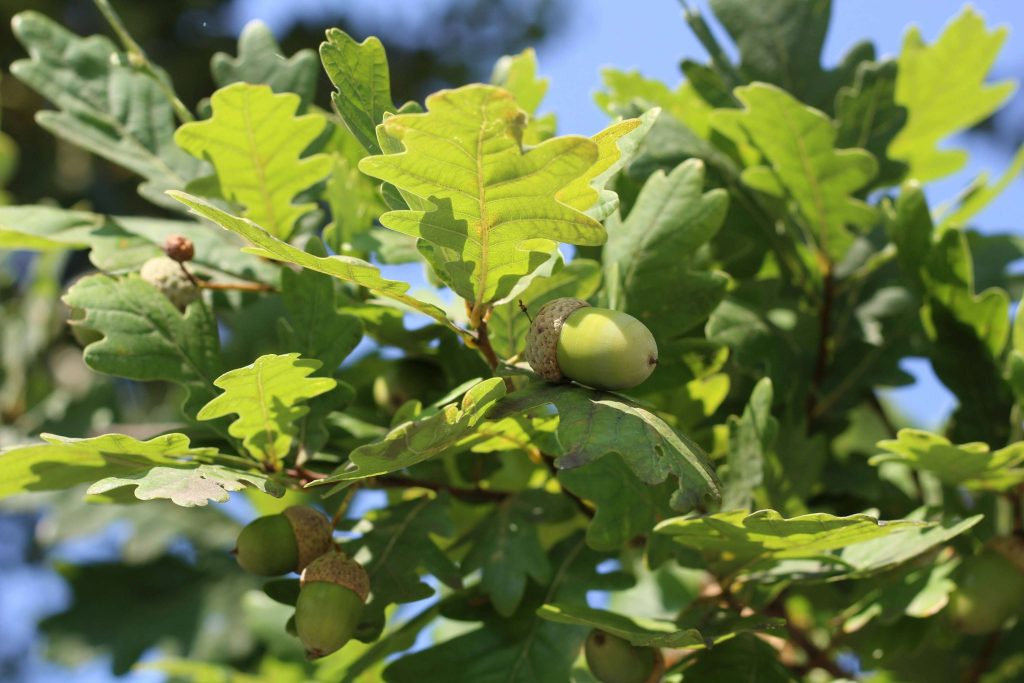
Provided no neighboring trees show oak wilt symptoms, trees can be returned to a normal pruning schedule with occasional monitoring.
What treatment can and cannot do
An oak wilt injection protects a healthy oak and can slow an early infection, but nothing reverses an advanced case, and there is no cure once a tree is far gone. The bigger win on most CSRA properties is the diagnosis itself: finding out the oak does not have oak wilt at all, and treating the real, far more common problem instead. Spending on the right problem is the whole point.
Why CSRA homeowners choose Arborwright

Diagnostic-first tree care
Most tree services start with “what do you want us to do?” We start with “what’s actually going on?” Arborwright is built around plant health care and diagnostic-first work, which means we look at your tree, identify what’s wrong, and tell you honestly what it needs. Sometimes that means treatment. Sometimes it means a pruning plan. Sometimes it means removal. We tell you which, with the evidence to back it up.
Our arborists know the CSRA’s soils, humid subtropical climate, and the tree species that thrive and struggle here. Local conditions matter. We show up prepared for them.
Science-based diagnostics
Every recommendation backed by plant pathology, soil science, and real evidence.
Honest recommendations
We tell you what your tree actually needs, even when it's less work for us.
The people behind Arborwright
Real credentials. Real expertise. Real local knowledge.

Burns Newsome
Founder & Plant Health Care Specialist
Licensed Applicator | B.S. Biology + M.S. Genetics | Former Vanderbilt Research Team
I come from a research background. Before founding Arborwright Tree Care, I spent several years as part of a research team at Vanderbilt University Medical Center, where careful observation and methodical thinking defined the job. I hold two degrees in the biological sciences, and I apply that same research-first mindset to every tree I evaluate.
What drives my work is a deep passion for healthy ecological landscapes. I believe most struggling trees can be saved when the right diagnosis comes first. Removal is a last resort, not a default. Across North Augusta, Aiken, Augusta, and the rest of the CSRA, I help homeowners understand what’s actually happening with their trees, from crape myrtle bark scale to root stress to storm damage, and build treatment plans backed by evidence instead of guesswork.
When I’m not in the field, I’m on my own land with my two boys: catching critters, fishing, and managing the property to support the greatest diversity of life it can hold. That’s how this business started. At some point, working within the constraints of my own backyard wasn’t enough. I wanted to care for the landscape around me in a meaningful way, and help the people in my community do the same. Arborwright is how I do that.
Thomas Wilson
ISA Certified Arborist®
ISA Certified Arborist® | ISA Member | 13 Years of Field Experience
I came up in tree work in Tennessee, where I spent years climbing, pruning, and learning how trees actually behave under load and stress. There is no shortcut for that kind of time in the canopy. When I moved to the CSRA, I brought that hands-on foundation with me and adapted it to a new set of species, the region’s soils, and a much longer growing season.
Earning my ISA Certified Arborist® credential held that field experience to a documented, tested standard. My focus is structure and risk: how a tree is built, where it is weak, and what it is likely to do in the next storm. I would rather find a failure point on a calm afternoon than after a limb is already down on someone’s roof.
What I value most is the work that keeps a mature tree standing. A large, established tree takes decades to replace, and most of the ones I assess can be kept healthy and sound when someone reads them early and acts on what they find. That is the part of this job I care about, and it is why I am glad to do it here in the CSRA.

Oak wilt treatment pricing
The on-site diagnosis is free. If treatment is warranted, propiconazole injection is typically priced per tree by trunk size and ranges depending on the factors below.
- Confirming the diagnosis or lab test
- Tree size and trunk diameter
- Number of oaks treated
- Injection or other treatment needed
- Root graft severing or removal
- One-time or ongoing protection
Free diagnosis includes
Your free diagnosis includes a close look at the oak and its symptoms, an honest determination of whether it is oak wilt or a look-alike, and itemized pricing for whatever the tree actually needs. If your oak does not have oak wilt, Burns will tell you, and treat the real problem instead. No obligation and no pressure.
Frequently asked questions
Everything homeowners ask about oak wilt and oak disease.
The on-site diagnosis is free. If treatment is warranted, propiconazole injection is usually priced per tree by trunk size, and confirming the diagnosis may include a lab test. Because true oak wilt is uncommon here, the more valuable service is often the diagnosis itself, which frequently finds a cheaper, more common problem instead. Arborwright prices the actual need, not an assumed disease.
Oak wilt is a fungal disease that invades an oak’s water-conducting vessels and causes the tree to block its own water flow, leading to rapid wilting, browning, and often death. It spreads through the connected roots of neighboring oaks and by sap beetles carrying spores to fresh wounds. It is a major problem in Texas and the Midwest and is taken seriously wherever oaks grow.
Oak wilt typically shows as leaves wilting and browning from the top of the canopy down, often with green or half-green leaves dropping early, and a tree declining fast over weeks rather than years. In live oaks, browning along the leaf veins is a telltale sign. Many other oak problems look similar, though, so the appearance points toward oak wilt without confirming it on its own.
Less than people fear. Oak wilt is widespread in central Texas and the Midwest and reaches the edges of the Southeast, with scattered outbreaks, but it is not established or common in the immediate CSRA. Most oaks here that look wilted have a different, more common problem. It is worth knowing the signs and taking seriously, but in this area an oak showing symptoms is far more likely to have something else.
No. There is no cure for oak wilt. The fungicide propiconazole, injected into the tree, can protect a healthy high-value oak or slow an early infection, but preventing and slowing a disease is not the same as curing it, and a tree already in steep decline cannot be saved. This is why early, accurate diagnosis matters so much, and why any claim of curing a far-gone oak should be treated with skepticism.
Almost never. Black or dark spots on oak leaves are usually a leaf disease like anthracnose or tubakia, or harmless leaf blister, none of which is oak wilt and most of which are cosmetic. Oak wilt shows as wilting and browning of whole leaves and rapid canopy decline, not defined spots. If your oak has spotted leaves, the likely cause is something far less serious, which a diagnosis will confirm.
It might not be. Yellowing leaves on an oak can come from many causes, including iron or manganese deficiency in our soils, poor drainage, a buried root flare, or general stress, all more common here than oak wilt. Oak wilt yellowing usually comes with fast wilting and leaf drop, not slow, even yellowing alone. The pattern and speed matter, which is why it is worth having looked at rather than guessed.
The single most important step is not pruning or wounding oaks during the high-risk spring and early summer, when the sap beetles that spread the fungus are most active, and painting any unavoidable wounds. Keeping oaks healthy, avoiding root damage, and dealing with a confirmed case quickly to stop root spread all help. Prevention is far more effective and far cheaper than treating an active infection.
The single most important step is not pruning or wounding oaks during the high-risk spring and early summer, when the sap beetles that spread the fungus are most active, and painting any unavoidable wounds. Keeping oaks healthy, avoiding root damage, and dealing with a confirmed case quickly to stop root spread all help. Prevention is far more effective and far cheaper than treating an active infection.
Most companies either do not understand oak wilt or will sell a treatment for any wilting oak. Arborwright tells you the truth: true oak wilt is uncommon in the CSRA, most wilting oaks have something else, and the diagnosis comes before any treatment. Burns Newsome is a Licensed Applicator with two degrees in the biological sciences, so the call on whether it is actually oak wilt is one you can trust.
Trusted by homeowners across the CSRA
Real reviews from real customers across North Augusta, Augusta, Aiken, and the CSRA. Want to be one of them? Schedule your free inspection.
Oak wilt diagnosis and treatment near you
Arborwright Tree Care provides plant health care, tree services, and arborist consultations across North Augusta, Augusta, Aiken, Evans, Martinez, and the surrounding CSRA. Find your area below.
North Augusta, SC
Hammond’s Ferry, Riverview Park, downtown North Augusta. Our home base.
Augusta, GA
West Augusta, Summerville, National Hills, Forest Hills, downtown.
Aiken, SC
Downtown Aiken, Houndslake, Woodside, Hitchcock Woods area.
Evans, GA
Riverwood Plantation, Evans to Locks, Kiokee.
Photo Credits
Ronald F. Billings, Texas A&M Forest Service, Bugwood.org
William M. Ciesla, Forest Health Management International, Bugwood.org
Fred Baker, Utah State University, Bugwood.org
Steven Katovich, Bugwood.org